
Who are the Yule Lads?
JORVIK Viking Centre has been taken over by the Icelandic Yule Lads! Luckily, we’ve acquired the files of researcher Dr Magnus Bjornsson. What follows are his research notes on these mysterious visitors, their peculiar habits and the incidents they’ve left in their wake.
A quick note on Icelandic names: The Yule Lads have some wonderfully unusual names, but they can be tricky to pronounce if you’re not familiar with Icelandic. We’ve included a simple pronunciation guide to help you say them aloud.
For years, reports of strange occurrences have been coming out of York. Increasingly, these incidents seem to be centred on JORVIK Viking Centre. At first, my investigations were fruitless. Victims reported missing food, while others complained that their kitchen utensils and cooking pots had been coated in a strange substance.
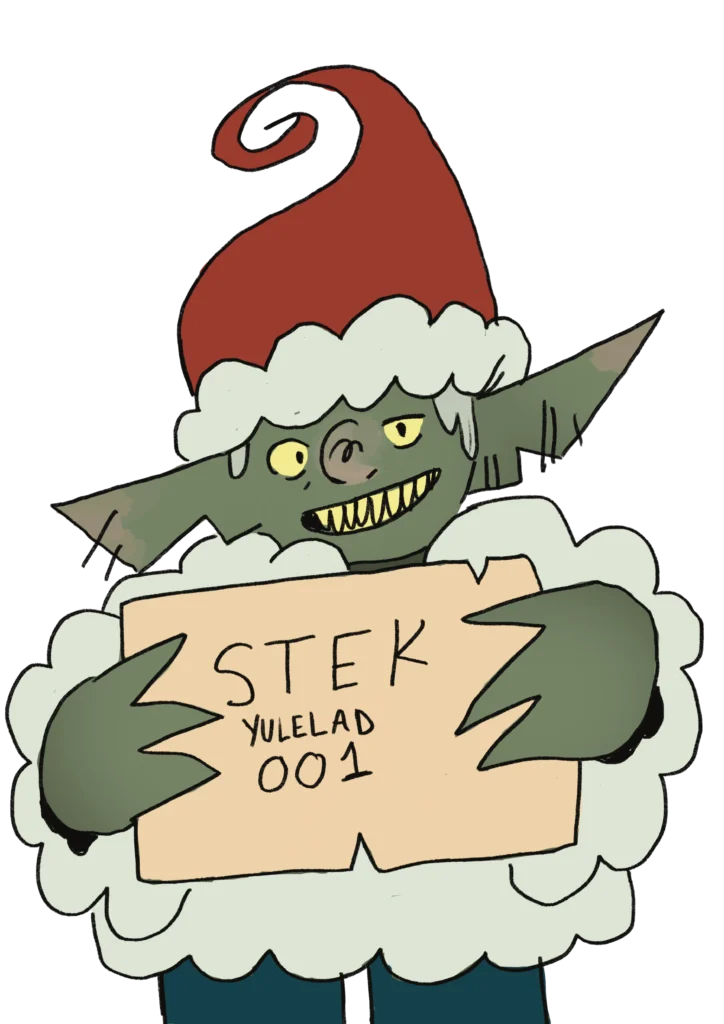
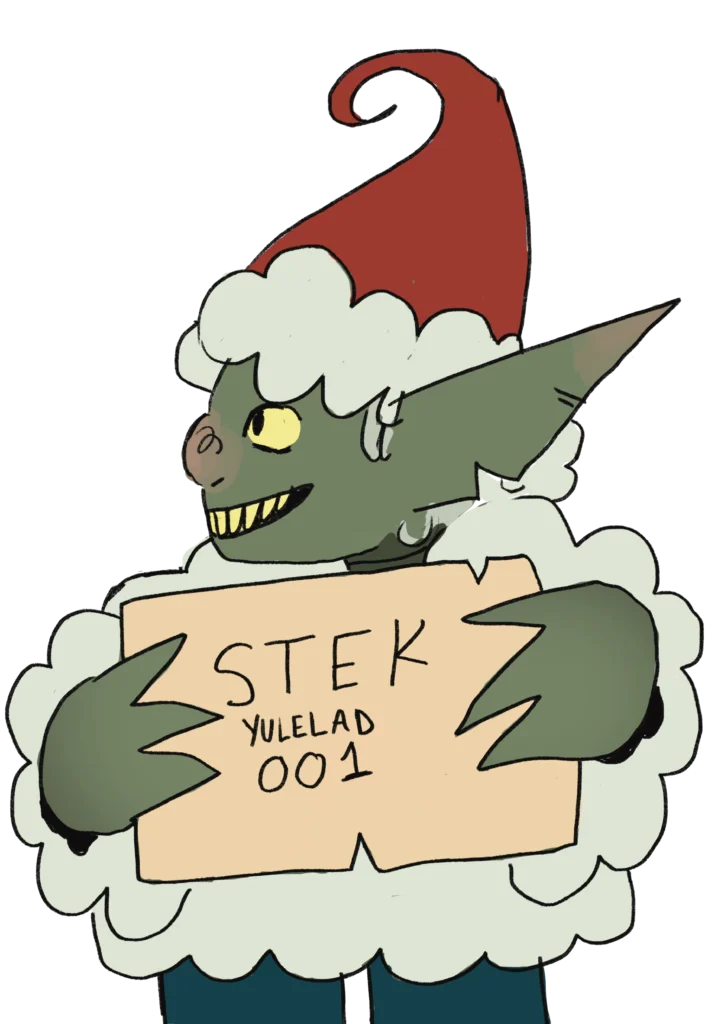
After years of painstaking research, I believe I’ve finally identified the culprits: the Icelandic Yule Lads. Fortunately, we even have their mugshots, courtesy of our contacts in Iceland.
Sheep-Cote Clod aka Stekkjastaur
Sheep-Cote Clod is a fascinating case. Known in Icelandic as Stekkjastaur (roughly: STEK-yah-stoyr), or simply Stekk, he is the first of the Yule Lads to arrive, appearing on 12th December.
According to Icelandic folklore, he sneaks into sheep pens and harasses the animals in an attempt to steal their milk. Stekk is notoriously stiff-legged, with legs as stiff as wooden pegs. Some accounts suggest this makes his milk-stealing rather difficult, although it doesn’t seem to have put him off.
What makes this particularly interesting is how closely his antics reflect traditional Icelandic farm life. Sheep provided wool, meat and other necessities, so a creature harassing the flock and attempting to steal milk would hardly have been welcomed by a farmer. Reports of these strange visitors stretch back generations. Are the Yule Lads immortal, or do they simply live exceptionally long lives? It’s too early to say. I’ll need to investigate this further.
Stekk appears to be the first of the Yule Lads to emerge from the mountains each Christmas. But where does he go afterwards? And, more importantly, where has he been hiding for the rest of the year?
Giljagaur aka Gully Gawk
Giljagaur (roughly: GIL-yah-goyr), or Gully Gawk as he is known in English, appears to be the next suspect on our list. Arriving on 13th December, he is said to hide in gullies before sneaking into cowsheds to steal milk.
For those unfamiliar with the term, a gully is a narrow channel or ravine, often carved out by flowing water. Quite why someone would choose to hide in one is beyond me, although I suppose it would provide a reasonable hiding place in the Icelandic countryside.
According to Icelandic folklore, Gully Gawk waits until farm workers are distracted before making his move. Rather than milking the cows himself, he steals the frothy cream that gathers on top of freshly collected milk. A remarkably specific crime, but a crime nonetheless.
What concerns me is how he manages this in York. One witness reported seeing a shadowy figure disappearing into an alleyway near the city walls, carrying two jugs of milk. Could this have been Gully Gawk? And if so, where did he get the milk?
I may need to investigate the local dairy supply.
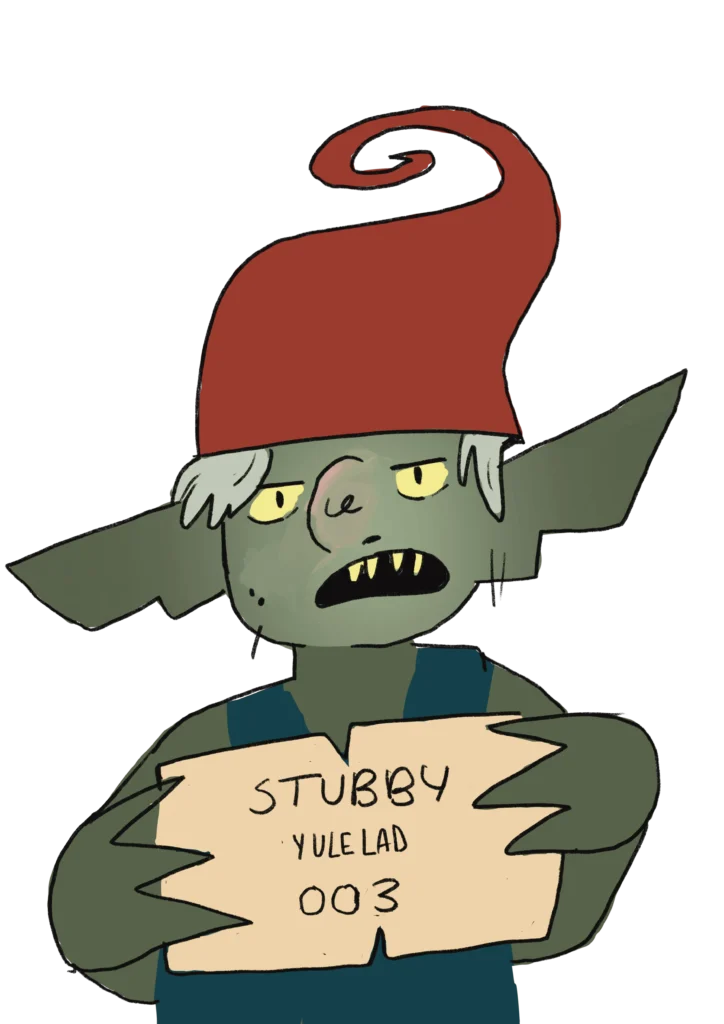
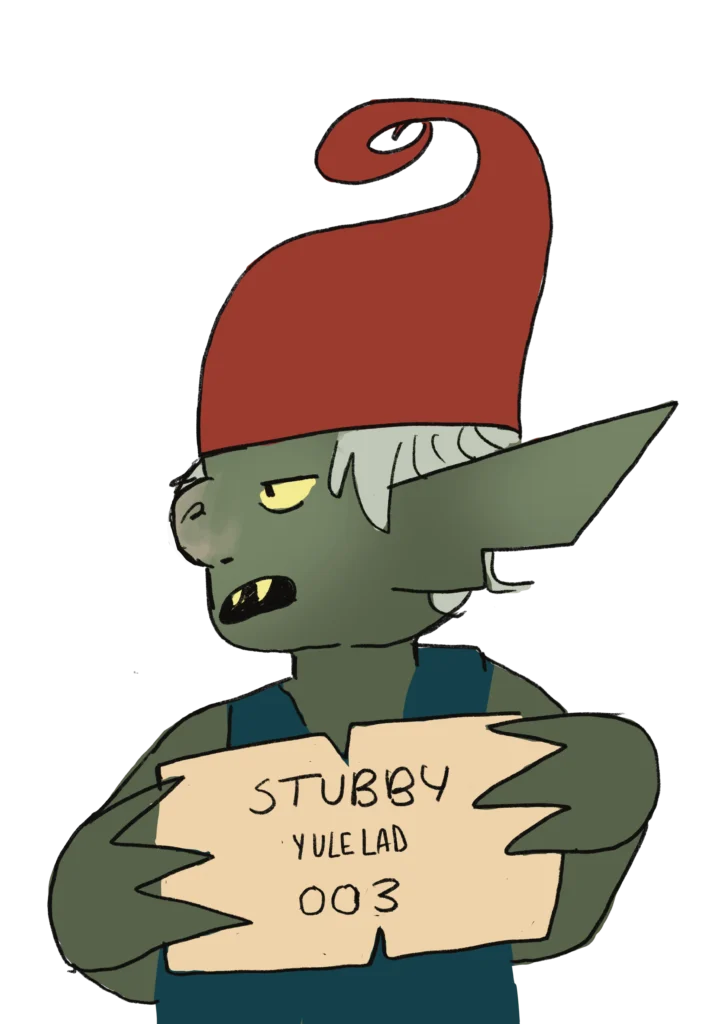
Stúfur aka Stubby
Our next Yule Lad tends to arrive on the 14th of December and goes by the name Stúfur (roughly: STOO-vur), or Stubby. Perhaps his nickname is a reference to his height; he is, after all, the shortest of the Yule Lads.
Reports suggest he is particularly fond of stealing frying pans. He isn’t interested in cooking anything. Instead, he scrapes off and eats the burnt bits of food stuck to the bottom! I have to admit, it’s an unusual delicacy. One witness had this to say:
“I’m not angry that he ate the leftovers. I’m more annoyed that he took my favourite pan!”
I suppose I’ll have to add another count of theft to the list of alleged crimes. Although, if he’s only interested in the burnt scraps, perhaps he’s doing the owners a favour.
I do wonder whether Stubby has any influence over which children receive presents and which receive potatoes at Christmas. Perhaps his grumpy disposition makes him particularly keen to punish the naughty ones? My sources assure me that presents will still be delivered this year, but I shall be keeping a close eye on the potato supply, just in case.
Þvörusleikir aka Spoon-Licker
Ah, the first of what I’ve affectionately named the Licker Triplets!
Þvörusleikir(THVUR-uh-slay-kir), or Spoon-Licker, is a particularly peculiar suspect. He is said to be exceptionally tall and thin, almost like a spindle. He has a habit of sneaking into kitchens to lick wooden stirring spoons clean, especially when the cook isn’t looking. Reports of this Yule Lad tend to come from near kitchens, including those behind restaurants, although he has occasionally been spotted near older houses. I wonder whether he only licks wooden spoons? In an age when metal cutlery is commonplace, he may find his opportunities somewhat limited.
Of course, wooden spoons are still widely used for cooking, but I suspect he prefers the long-handled stirring spoons of old. I shall have to investigate whether his tastes have changed over the centuries. If I find him licking a silicone spatula, I may need to reconsider everything I thought I knew about this case.
Pottasleikir aka Pot-Licker
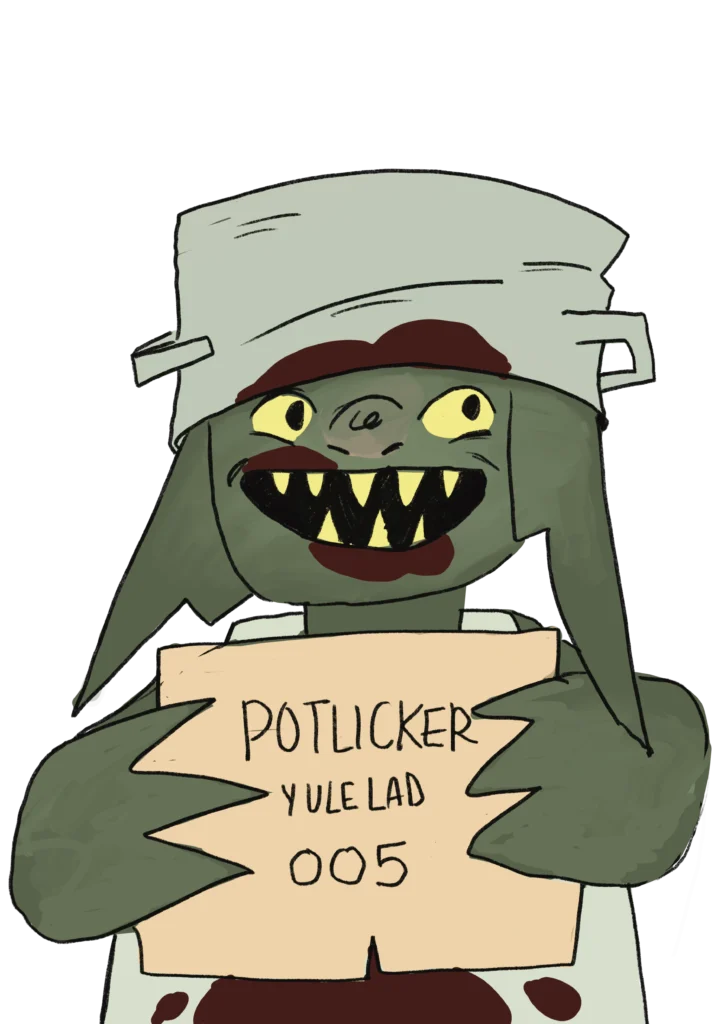
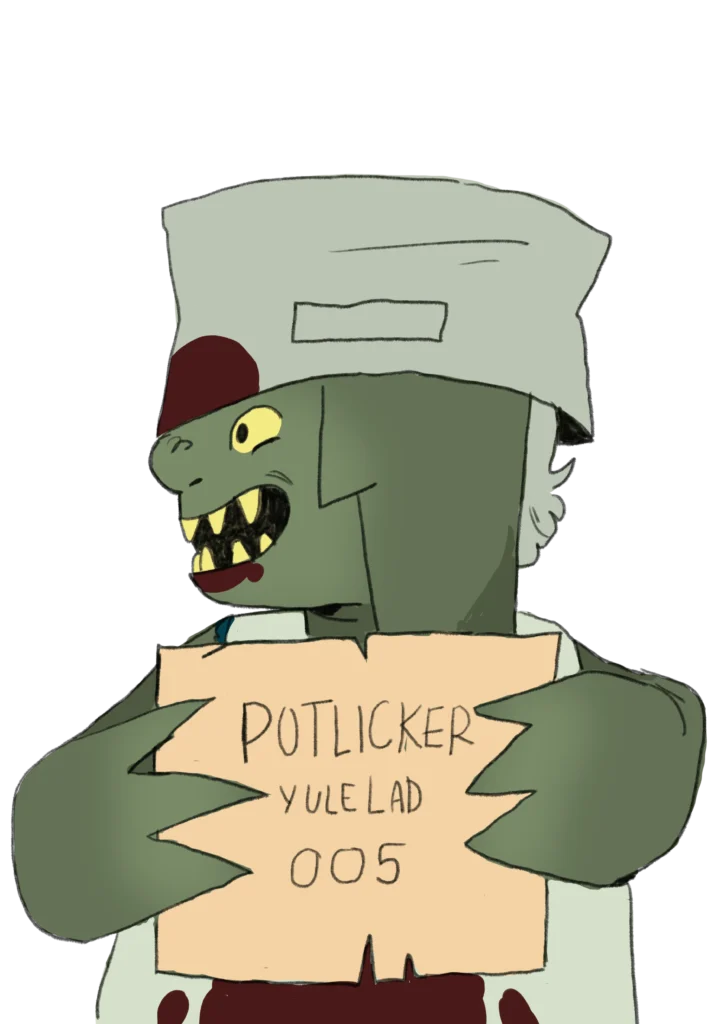
This Yule Lad has caused some confusion in my notes. He is known as Pottasleikir(POT-ta-slay-kir), or Pot-Licker, although another name appears in some accounts: Pottaskefill, meaning Pot-Scraper. These names are associated with the same Yule Lad in Icelandic folklore, so I can finally put that particular mystery to rest.
Like Spoon-Licker, he has a particular interest in kitchen leftovers. His preferred targets, however, are cooking pots. He scrapes and licks the remnants from inside them, leaving very little behind for anyone else.
His methods are rather more cunning than I first suspected. Some accounts suggest he knocks at the door to distract the occupants. While they go to answer it, he sneaks into the kitchen and gets to work on the pots. This would explain why so many victims report hearing a knock shortly before discovering their leftovers have vanished.
Why do so many of the Yule Lads steal food? And why are they so interested in leftovers? Is it because their mother, Grýla (GREE-la), was so terrifying? According to Icelandic folklore, she carried off naughty children. Or is it because their father, Leppalúði (LEP-pa-LOO-thee), was so lazy that leftovers were all they could ever find to eat?
I must admit, the more I learn about this family, the more questions I have.
Hurðaskellir aka Door-Slammer
This is one of the few Yule Lads I’ve actually had dealings with. Hurðaskellir (HUR-tha-sket-lir), or Door-Slammer, visited my home on 18th December 1989. I remember it like it was yesterday.
I’d just finished my evening reading by the fire and was getting ready for bed. I was tired and desperately needed some sleep. After checking that the doors were locked, I retired upstairs. Everything was quiet. Then, just as I was dozing off, there was a tremendous bang! I shot out of bed and searched the house. There was nobody there. I checked the locks, returned to bed and tried to settle down. Just as I was on the cusp of sleep, another bang rang out. This continued throughout the night. In total, I counted ten bangs. When I got up for work the next morning, I discovered that the back door was wide open.
My research suggests this is typical Door-Slammer behaviour. Unlike some of his brothers, who prefer to steal food, his particular speciality is slamming doors in the middle of the night to keep people awake. Whether he does it for amusement or simply because he enjoys making a nuisance of himself remains unclear. Of all the suspects I’ve investigated, this is one I’d be perfectly happy never to see or hear again.
Skyrgámur aka Skyr-Gobbler
With this Yule Lad, we return to the familiar theme of food theft. Skyrgámur(SKEER-gow-mur), or Skyr-Gobbler, arrives on 19th December and has an insatiable appetite for skyr, a traditional Icelandic dairy food. It is often compared to yoghurt because of its thick, creamy consistency, although it is made using a different process and is sometimes described as being closer to a fresh cheese. Skyr has been part of Icelandic food culture for centuries, making it a particularly valuable target for our suspect.
My concern is the sheer quantity he consumes. Skyr-Gobbler doesn’t appear satisfied with a small bowl or two. He wants the lot. I am not a nutritionist, but I suspect that eating an entire household’s supply in one sitting rather undermines the benefits of a balanced diet.
I have received a report of a particularly brazen incident on a small island off the north coast of Scotland. According to the witness, a catering worker returned to the kitchen to discover that a four-week supply of skyr had disappeared overnight. The witness was understood to have said:
“Och, ah cannae believe it! The wee yin’s gone through all ma skyr! The cheeky wee so-and-so!”
My Scottish is a little rusty, but I believe this translates roughly as, “I can’t believe it! He’s eaten all my skyr! The cheek of him!” There may have been some additional choice language that I have chosen not to record in these notes.
Bjúgnakrækir aka Sausage-Swiper
I feel that this particular Yule Lad may have fallen on hard times. Bjúgnakrækir (BYOOG-na-krye-kir), better known as Sausage-Swiper, arrives on 20th December and has a particular fondness for sausages. Traditionally, he would climb into the rafters of people’s homes and wait for an opportunity to steal sausages hanging there to smoke. Before modern refrigeration, smoking was an important way to preserve food, so rafters could be put to rather more practical use than they are today.
Unfortunately for Sausage-Swiper, most modern homes no longer have sausages hanging from their ceilings. I have occasionally spotted them hanging in my local butcher’s. Perhaps this explains the Great Sausage Heist.
A butcher’s shop in York reported that its sausages had mysteriously disappeared. At the time, the incident was dismissed as an ordinary theft, but I now wonder whether we were dealing with something far more unusual. I have requested the original incident report. If my suspicions are correct, we may have our first recorded York sighting of Sausage-Swiper.
Gluggagægir aka Window-Peeper
Gluggagægir (GLOOG-a-guy-ir), or Window-Peeper, is another suspect I’ve encountered personally. He is sometimes known as Peep to his friends. His usual method is to peer through windows, looking for objects that take his fancy. Unlike some of his brothers, who seem driven almost entirely by hunger, Peep appears to be motivated by curiosity as much as theft. If he spots something he likes, he may try to take it.
I first encountered him as a child. I remember looking towards my bedroom window and seeing a small figure peering inside. His eyes seemed fixed on my stuffed cat, Sir Pounce Alot. In my later encounters, I’ve found Peep to be rather timid, even quite sweet at times. However, I wouldn’t recommend leaving anything valuable near a window when he is about.
I’ve often wondered whether Peep plays a role in deciding which children receive presents at Christmas. In Iceland, children traditionally place a shoe on the windowsill during the nights leading up to Christmas. The Yule Lads leave small gifts for well-behaved children, while those who have misbehaved may find a potato instead. Perhaps Peep uses his window-peeping to check which children deserve a gift? Or perhaps he is simply looking for something to steal. I have yet to find conclusive evidence either way.
There is, however, one serious concern with his methods. Peering through people’s windows at night is hardly acceptable behaviour. Whatever his intentions, I would advise keeping your curtains closed.
Gáttaþefur aka Doorway-Sniffer
Given the sheer number of Yule Lads (thirteen, I believe), Gáttaþefur (GOWT-ta-thev-ur), or Doorway-Sniffer, is perhaps one of the oddest. His defining characteristic is his enormous nose, which apparently allows him to sniff out food from remarkable distances. If there weren’t reports of him doing precisely this, I’d suspect someone had been watching too many cartoons.
Unlike some of his brothers, who prefer to steal food by climbing into cupboards or scraping out cooking pots, Doorway-Sniffer appears to rely on his nose to locate his next meal. He seems to be one of the less troublesome Yule Lads, although I imagine hearing suspicious sniffing noises outside your kitchen door in the middle of the night would be rather disconcerting.
Several sightings place him in York on or around December 22nd. Most concerning is a report of an unusually large-nosed figure caught trespassing in the Shambles Market after hours. Could this have been Doorway-Sniffer? The timing certainly fits. He may not be the most dangerous of the Yule Lads, but I would advise keeping food securely stored and kitchen doors firmly shut. One can never be too careful.
Ketkrókur aka Meat-Hook
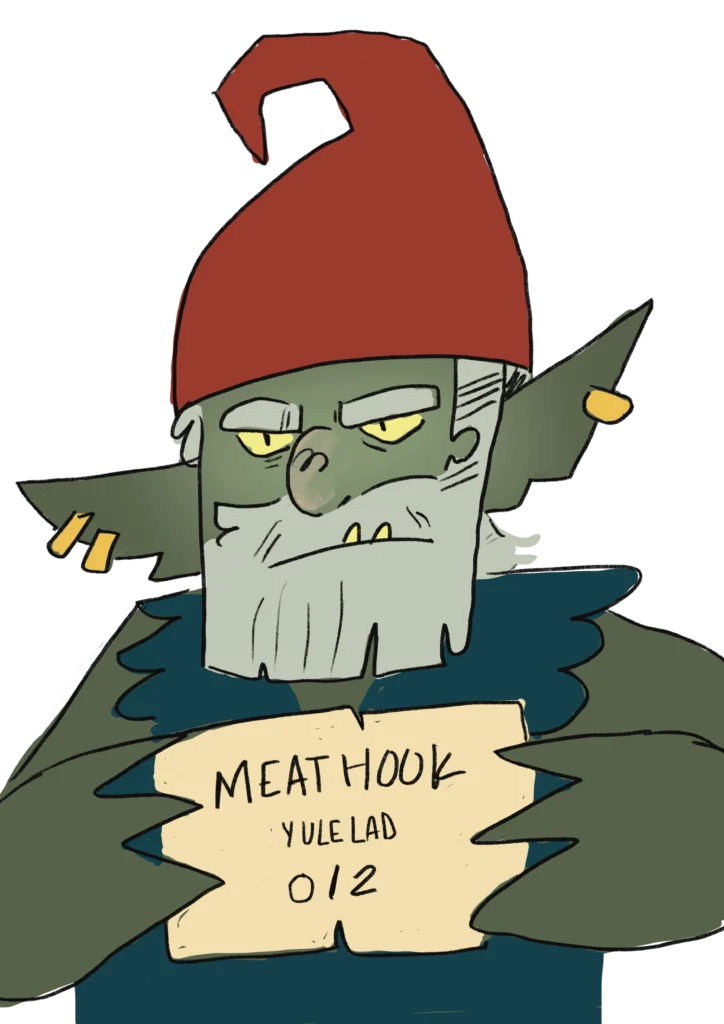
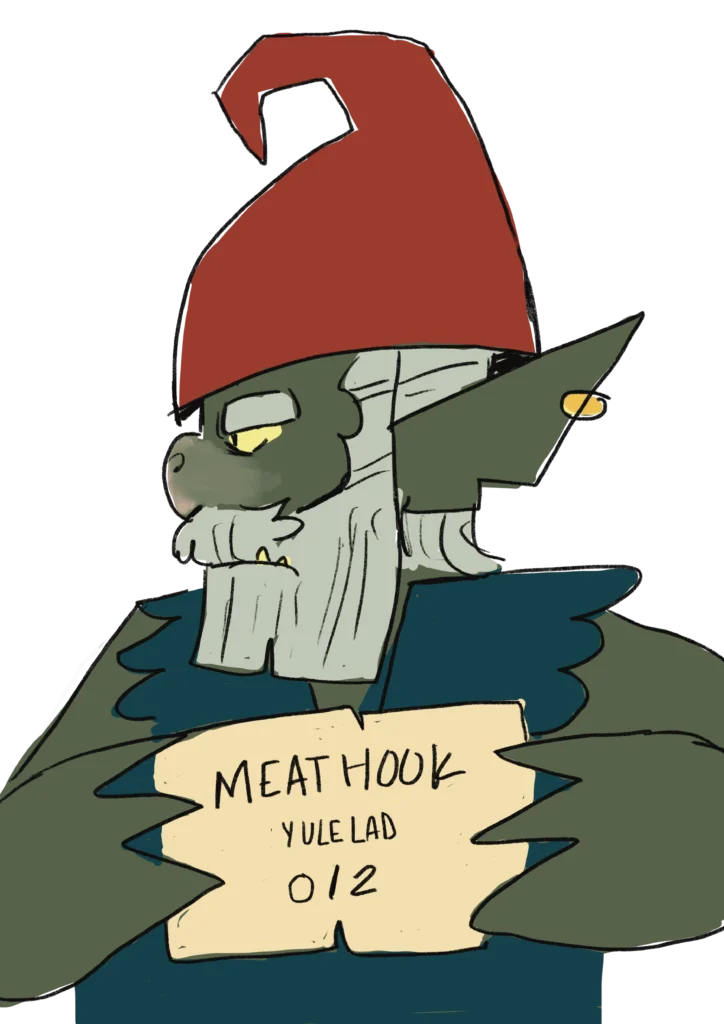
The penultimate Yule Lad, Ketkrókur (KET-krow-kur), or Meat-Hook, arrives on 23rd December and shares his brothers’ fondness for stealing food. However, his methods are rather more inventive. Rather than sneaking into kitchens or hiding beneath beds, he uses a hook to steal meat, traditionally lowering it down chimneys to snatch whatever has been left cooking or smoking. The hook gives him a considerable reach, allowing him to steal food without even entering the building.
I know this because I once encountered him myself. I was visiting my grandmother in Iceland when, in the middle of the night, I heard her shout from downstairs:
“Not my late-night jerky! Oh, my lord, it’s Ketkrókur!”
I then heard cackling, followed by footsteps running across the roof. Naturally, I rushed to the window to investigate. There, silhouetted against the winter sky, was Meat-Hook. He was using his hook to lower himself down the side of the house, his arms bulging with smoked meat as he disappeared into the darkness.
I have spent years wondering how he managed to carry so much meat without falling over. Perhaps his diet has given him exceptional upper-body strength? The incident remains one of my most memorable encounters with a Yule Lad.
Kertasníkir aka Candle-Beggar
Kertasníkir (KER-ta-snee-kir) is the final Yule Lad, arriving on 24th December. Their name is usually translated as Candle-Stealer, although Candle-Beggar is another English rendering. Whatever we call them, the result is much the same: candles have a habit of disappearing whenever they are around.
Unlike some of their brothers, Candle-Stealer doesn’t appear to be interested in food in the usual sense. Instead, they steal candles, which folklore traditionally describes them as eating. My research suggests that they have a particular fondness for candles made from animal fat.
This may sound like a relatively harmless habit, but we must remember that candles were once an important source of light. Before electric lighting, losing a candle could leave a household struggling to see after dark. During the long Icelandic winter, artificial light was particularly useful. I can only imagine the frustration of discovering that your candles have vanished just when you need them most.
There is, however, one possible advantage to their arrival. Once Candle-Stealer has finished their business, all thirteen Yule Lads have arrived, and their Christmas visit is complete. Perhaps we can finally enjoy a peaceful Christmas without food disappearing, doors slamming or strange figures lurking outside our windows.
Then again, I have been investigating these creatures for years, and I have learned not to count on peace and quiet.