
Viking Weapons
When we think about Vikings, many of us imagine fierce hairy men charging headlong into battle with huge axes, swords and armour. While this image is not completely wrong, the reality was much more complicated. Let’s look a little deeper at Viking Weapons.
Not every Viking was a professional warrior. In fact, the word ‘Viking’ is a bit like a job title, describing ‘raiders’ or ‘pirates’, but it is not a word most Scandinavians would have used to describe themselves. Many of the Norse settlers in England were farmers, traders, craftspeople and fishermen who only fought when they needed to protect their homes, join a raid or defend their community.
Archaeologists have discovered thousands of fragments of Viking weapons across the Viking world, including many objects found here in York. These discoveries help us understand not only how Vikings fought, but also the people who carried these weapons.
Some weapons were specially made for battle, while others were everyday tools that could be used when danger arrived.
So, what did the Vikings use?
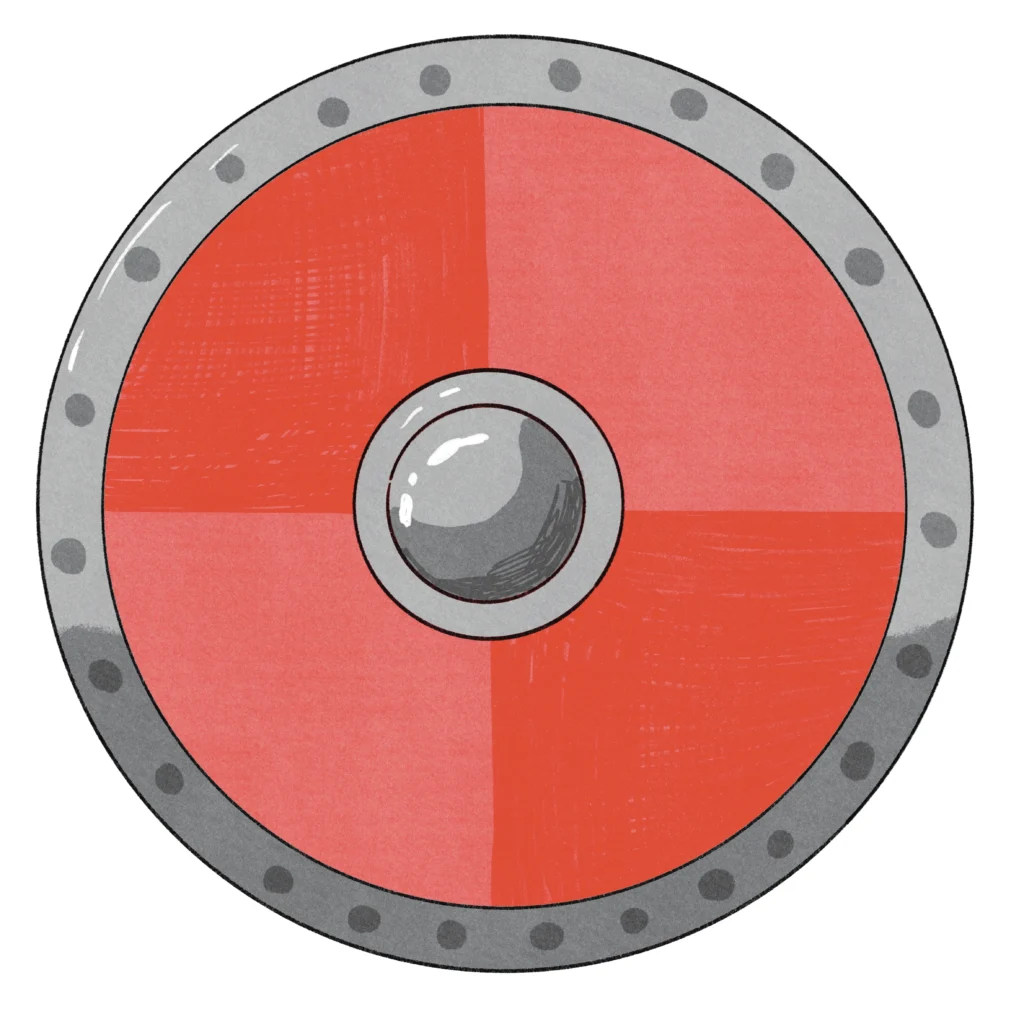
Shields
If you asked a Viking to choose just one piece of equipment for battle, they probably wouldn’t choose a sword. They’d choose a shield.
We do not know exactly how every Viking shield looked, but a well-preserved example discovered at Trelleborg in Denmark gives us some clues. This round shield was around 85cm wide and was made from wooden planks, with an iron boss in the centre to protect the warrior’s hand.
One side of the shield was covered calfskin, which helped strengthen the wood and protect it from damage. Some shields were decorated with painted designs or symbols, possibly helping warriors identify each other during battle.
But a Viking shield was not just something to hide behind. It was a vital part of how Vikings fought.
Many Viking battles involved a formation called a shield wall. Warriors would stand side by side, holding their shields together to create a strong defensive barrier. Think of it a bit like a rugby scrum… just with a lot more pointy sticks.
Fighters often worked in pairs, with one person protecting their companion while the other attacked. This could have been a father and son, blood brothers (people who have sworn an oath to each other) or even a married couple. One would pin the enemy shield while the other hit their exposed chest. This allowed the Vikings to overwhelm their opponents.
Knives or Seaxes
For Vikings, carrying a knife was just part of everyday life. In the same way that many of us today would not leave the house without our keys or mobile phone, a Viking would rarely go anywhere without a knife at their side.
These knives were useful everyday tools, used for tasks such as preparing food, working with materials and carrying out everyday jobs. However, they could also become weapons when needed, whether during a raid, a battle or simply to defend yourself.
The Old English word seax referred to a type of single-edged knife. Adult men would often carry different sizes, including the smaller scramasax (sometimes translated as “injury knife”) and the larger langseax (“long knife”), which could be used for hunting or fighting.
Most everyday knives were fairly simple, but archaeologists have discovered some single-edged blades from Scandinavia that were modified to look more like swords. These weapons sometimes had handles made from materials such as antler or whalebone, although wood and leather were more common.
While they were not as finely balanced or carefully engineered as a true sword, these larger seaxes would still have been impressive weapons. They combined the usefulness of an everyday tool with the ability to become a dangerous weapon when needed.


Spears
When Vikings finally made it to the battlefield, the weapon you’d be most likely to see wasn’t a sword or an axe. It was a spear.
That might sound surprising, but the spear was one of the most versatile weapons a Viking could own. It allowed warriors to injure or even kill an enemy from a safer distance while keeping them at bay. Think about it. If you’re charging towards someone armed with what is essentially a long stick with a sharp point on the end, while you’re only carrying a sword, you’re going to have a hard time getting close enough to use it… especially if they keep poking you in the shoulder! That said, a spear wasn’t just useful at a distance. With enough training, a skilled warrior could also use one very effectively in close combat.
Another reason spears were so popular was that they were relatively cheap to make. The amount of metal needed for a spearhead was similar to that required for a knife, making them far more affordable than swords. Spearheads also came in many different designs, from light javelins that could be thrown to longer spears built for hand-to-hand fighting.
Your opposition could also use spears against you. One particularly nasty example was the heavy throwing spear called the angon, which is sometimes found in Anglo-Saxon burials in England. Its long, barbed head was designed to punch through an enemy’s shield, making it difficult to pull back out again and leaving the shield heavy, awkward and much less useful.
There was one final reason spears were important to the Vikings. They also held a special place in Norse mythology. Odin, king of the gods and ruler of Asgard, carried the legendary spear Gungnir (goong-neer). According to Norse legend, Gungnir was forged by the dwarves of Svartálfheim (svart-alf-hame) and would always strike its target, no matter who threw it. It became a symbol of divine authority, power and fate.
Let’s be honest, any weapon with its own name is automatically about ten times cooler.
Speaking of sharp pointy things…
Archery
When it comes to arrowheads, there are two main designs: the broadhead and the bodkin.
Broadheads are the standard diamond or leaf-shaped arrowheads that most of us picture when we think of arrows. They were designed to cut into a target and create large open wounds. However, broadheads did not always penetrate shields or armour.
That’s where the bodkin came in.
Bodkins had a much narrower, more aerodynamic design, with heads typically measuring between two and six inches long. This shape was intentional, as they were designed to punch through armour rather than slice into a target.
Fired from a powerful enough bow, bodkin points could penetrate leather, wood and even some types of mail armour, making them particularly dangerous on the battlefield. As impressive as they sound, they were far less useful for hunting and seem to have been much less common during the Viking Age than broadheads.

Arrowheads
When it comes to arrowheads, there are two main designs: the broadhead and the bodkin.
Broadheads are the standard diamond or leaf-shaped arrowheads that most of us picture when we think of arrows. They were designed to cut into a target and create large open wounds. However, broadheads did not always penetrate shields or armour.
That’s where the bodkin came in.
Bodkins had a much narrower, more aerodynamic design, with heads typically measuring between two and six inches long. This shape was intentional, as they were designed to punch through armour rather than slice into a target.
Fired from a powerful enough bow, bodkin points could penetrate leather, wood and even some types of mail armour, making them particularly dangerous on the battlefield. As impressive as they sound, they were far less useful for hunting and seem to have been much less common during the Viking Age than broadheads.
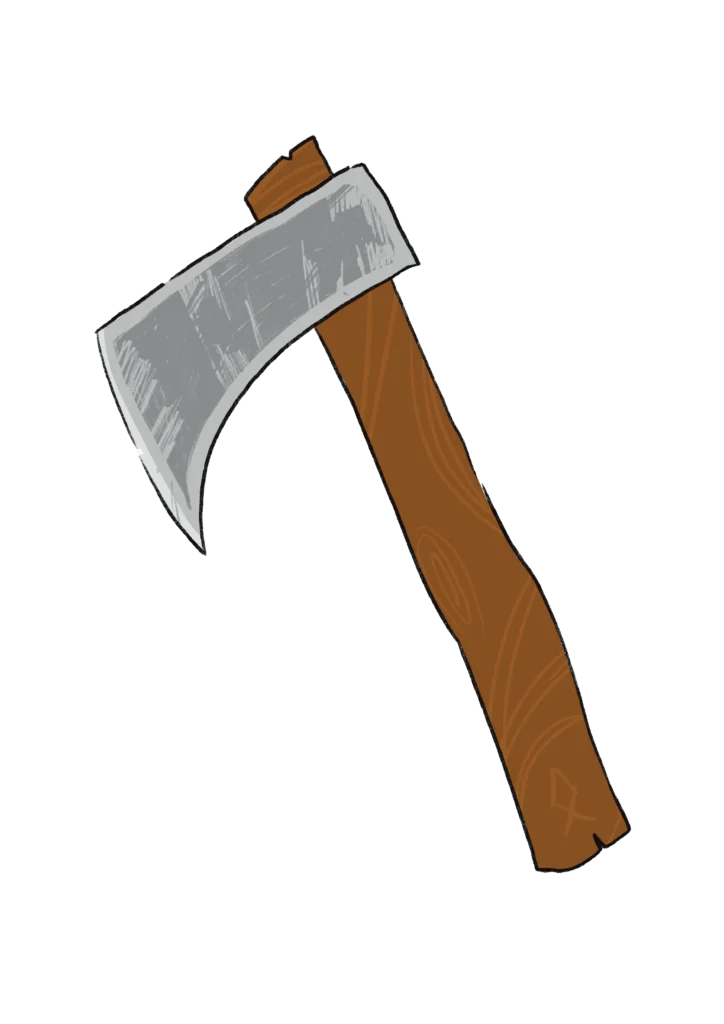
Axes
When we think of Vikings in battle, most of us probably picture someone charging towards us swinging a huge axe. It’s a bit like imagining a knight with a sword and shield or a cowboy with a revolver. Certain images just stick with us, and films, games and documentaries have helped reinforce the idea of the axe-wielding Viking.
It is certainly true that Vikings used axes on the battlefield, and archaeological evidence shows that Viking-age axes came in all shapes and sizes. Some had blades only three inches long, while the largest battle axes could measure over ten inches across. Many had a distinctive “beard” with the lower edge of the blade extended below the socket where it attached to the handle. This clever design made the axe lighter while giving the user more cutting edge and better control.
Smaller axes were incredibly versatile. They were used for chopping firewood, building houses and ships, and countless other everyday jobs. If danger appeared, the same tool could quickly become a weapon. In battle, smaller axes could even be thrown to disrupt enemy lines before the fighting closed in. They were also extremely useful in close combat. The bearded blade could hook onto the rim of an enemy’s shield, catch another weapon or, in some cases, even snag an opponent’s arm or leg.
Dane Axes
The larger Dane axe (sometimes called a long axe) was a different beast altogether. Mounted on a long wooden shaft, it gave its user much greater reach and is often considered the forerunner of later European polearms (weapons with long handles). These axes could be devastating in the hands of an experienced warrior. Historical accounts describe them cutting through shields and armour and, in some cases, turning one warrior into two separate archaeological discoveries with a single blow.
Despite their fearsome reputation, Dane axes weren’t easy to use. Their size meant they required strength, training and plenty of space, making them weapons best suited to experienced fighters rather than everyday farmers called up for battle.
And yet, impressive as axes were, they weren’t the most prized weapon a Viking could own…
Swords
Swords stood apart from every other Viking weapon for two very good reasons. Unlike axes, spears or bows, a sword had only one job: fighting. They existed purely for combat, making them one of the most intimidating weapons a Viking could own.
They were also expensive. Despite what films and television might have you believe, not everyone wandered around carrying a sword. The amount of metal and skill needed to make one meant they were valuable family heirlooms, often passed down from one generation to the next. If you owned a sword, you were probably someone of considerable wealth or status, or perhaps you’d taken it from someone who once was.
Vikings typically carried cross-hilt or broadswords, like the famous Cawood Sword, which was discovered in the River Ouse not far from York during the 1800s. Archaeologists believe it may have spent around 700 years lying on the riverbed before it was found. These swords were double-edged (both sides of the blade were sharp), featured a fuller, often had beautifully decorated hilts (sometimes including whalebone) and were designed to be used with one hand.
Viking swords generally weighed between two-and-a-half and five-and-a-half pounds (or, if that doesn’t mean much to you, somewhere between four cans of baked beans and a large whole chicken). Despite looking heavy, they were carefully balanced and made up of four main parts: the blade, the fuller, the quillon and the pommel.
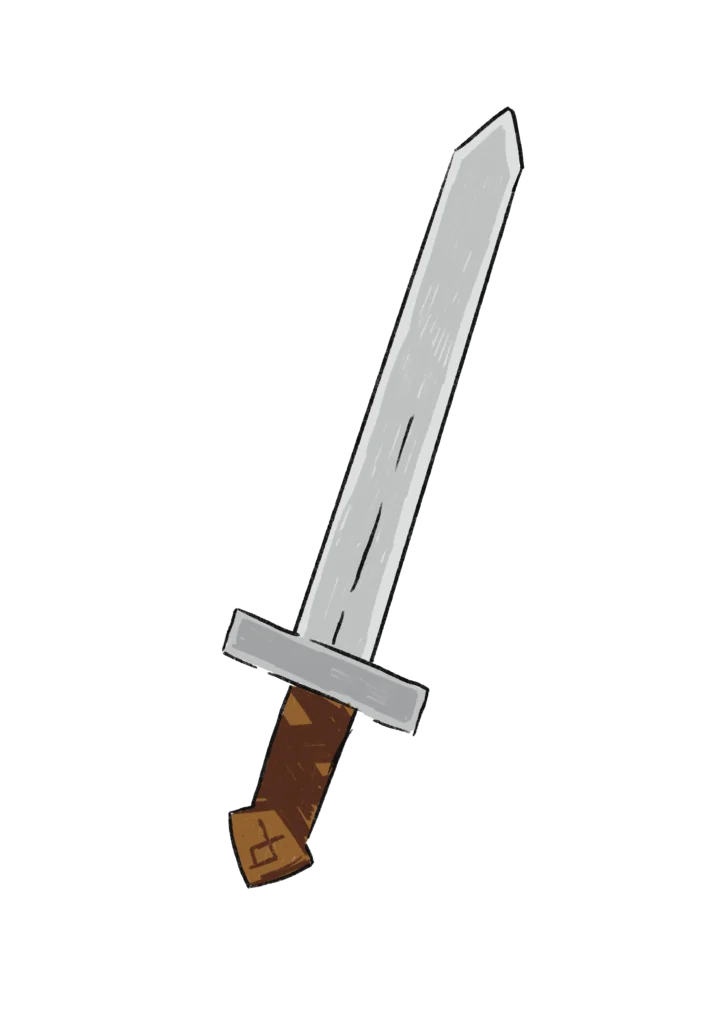
Parts of a Viking Sword
The blade was, of course, the business end of the sword and could deliver devastating blows. Running down the middle was the fuller, a groove often nicknamed the “blood channel”. Despite the nickname, its real purpose was to reduce the weight of the blade without making it weaker.
Next came the quillon (better known today as the cross-guard). This protected the warrior’s hand and fingers, which were obvious targets during combat. After all, if you couldn’t hold your weapon properly, the fight was probably over.
Finally, there was the pommel – the rounded piece at the base of the handle. This acted as a counterweight, helping balance the sword and making it quicker and easier to control. Without it, the blade would have been much more awkward to swing. The pommel could even be used as a club in close combat. It’s often said this is where the phrase “to pummel” someone comes from.

Mail Armour
We have spent a lot of time looking at what Vikings used to fight, so let’s look at what they wore in battle.
For many Viking warriors, protection would have been fairly simple. They may have worn leather greaves to protect their lower legs, padded jackets or other garments made from animal hide. These would have offered some protection, but they were nowhere near as effective as metal armour. This is why the shield was such an important part of Viking warfare. It was often the main thing standing between a warrior and an enemy’s weapon.
If you were wealthy or important enough, you may have been able to afford mail armour (more commonly known as chainmail today). However, this was not something every Viking warrior owned. Archaeologists and historians believe that only a small number of Vikings would have had access to iron helmets or mail armour. Like swords, these items were valuable and may have been passed down through families as treasured possessions.
There were some exceptions. Some professional warriors and mercenaries were known to have better equipment, including iron armour, but for most people it would have been far beyond their reach.
How Was Mail Armour Made?
So why was mail armour so rare? The answer is simple: it was incredibly expensive and time-consuming to make. This was partly because of the amount of iron needed, but also because every single link had to be carefully made and connected. Imagine making hundreds (or even thousands) of tiny iron rings and then having to join every single one by hand!
The surviving examples we have show just how impressive this craftsmanship was. Mail was made from thousands of tiny iron rings, each individually riveted together. Producing a single shirt took an enormous amount of time and skill, making it one of the most expensive pieces of equipment a Viking could own.
Mail armour was extremely effective because it helped stop blades from cutting directly into the body. It was also much more flexible than the later plate armour worn by medieval knights. However, it was not perfect. It was still made from metal, meaning it was heavy, with a typical mail shirt weighing somewhere between 22 and 33 pounds (at the heavier end, that is like carrying an office chair on your back all day!).
Mail could also be damaged. A single broken section of the chain could create a weakness that an enemy might exploit. So again, the shield was still an essential piece of equipment for even the wealthier Viking warrior!
Where are the horned helmets?
We’ve managed to get this far without mentioning them, but if we had to guess, you’ve probably been wondering when we’re going to talk about horned helmets. Here’s the answer: we aren’t!
Despite what films, cartoons and fancy dress costumes might suggest, there is no archaeological evidence that Viking warriors wore horned helmets into battle. The idea became popular during the 1800s when costume designers wanted Vikings to look more dramatic on stage.
We’d also like to point out that having two large horns sticking out of the top of your helmet would make them perfect targets for an enemy to grab or smash into your own head.
Real Viking helmets were much simpler—and much more practical. Unfortunately, there aren’t many complete Viking helmets for archaeologists to study. This may be because they were expensive, carefully made from shaped iron and steel, and could have been melted down and reused once they were no longer needed. Unlike swords and spears, helmets also don’t seem to have been commonly placed in graves or deliberately deposited in rivers and lakes.
We also can’t be certain that every Viking warrior wore a helmet. There are several Viking artworks showing warriors wearing them, but the archaeological evidence is surprisingly limited.
One of the best examples found in England comes from Yarm in North Yorkshire. This 10th-century iron helmet has a distinctive “spectacle mask” at the front, protecting the nose and the area around the eyes. A similar feature can be seen on the almost-complete Gjermundbu helmet found in Norway
What Viking Weapons Really Tell Us
Archaeology shows us that Viking weapons were as varied as the people who carried them. Some warriors owned beautifully crafted swords passed down through generations, while others fought with little more than a spear, an axe or the same knife they used every day. Perhaps the biggest lesson archaeology teaches us about Viking weapons is how much they were a reflection of the people who carried them.